

It’s officially fall, and by the time you read this you may have already harvested your first field of cotton for the year, which means it won’t be long before it’s time to plant cover crops. With so many different types of covers/species/cultivars/mixes floating around now, it’s worth digging into how to make sure you are selecting the correct species (or mix) for your “growing window” before it’s go time.
Just like yield with a cash crop, we want to manipulate our cover crop to maximize growth potential in the time it’s in the ground – more growth generally means greater benefit to our system (i.e. biomass, weed suppression, soil erosion prevention, etc.). This means it’s important to think about species selection and a realistic timeline for how many days we expect to have that cover in the ground for – before we plant the first seed.
To be successful, we need to understand how much time we reasonably have between harvesting our 2026 cash crop/planting our cover crop, and when we intend to terminate before next year’s cash crop planting (2027). With an understanding of when we intend to plant the cover and when we will terminate before the next crop, will that leave enough days for the species we select to accumulate enough biomass for us to get our money worth? Here’s a couple of planting/terminating window scenarios:
| Cover Crop Planting Date | Termination Date | Growing Window (Days) |
| October 15 | March 15 | 150 |
| October 15 | April 15 | 180 |
| November 1 | March 15 | 135 |
| November 1 | April 15 | 165 |
| November 15 | March 15 | 120 |
| November 15 | April 15 | 150 |
| December 1 | March 15 | 105 |
| December 1 | April 15 | 135 |
Understanding how many days we are working with can help us make sure we select a species (and variety) that fits our window and serves our goals. Just keep in mind, your cover crop is not going to be growing the whole time it’s in the ground – you will see early season growth before the temps turn off cold, then growth with start again in the spring. Generally, the more time you can give that cover crop to grow in the spring (warming temps, longer days, rapid growth), the more biomass you will generate. Unless you are terminating ahead of corn, I’d encourage you to consider holding off on terminating until closer to planting cotton (even though it’s tempting to just terminate everything in March while there’s time!).
For cereal rye, the most common variety we see in Georgia is Wrens Abruzzi, which matures around ~150 days. An earlier maturing variety such as FL401 (~125 days) may be a better fit for a tighter planting window, such as a late harvested cotton crop to be followed by an earlier cash crop planting date in the spring. A variety like FL401 (or similar) tends to be more aggressive in its early season growth, capitalizing on the days above 40F leading into “true winter”, which means a faster jump on biomass accumulation in the spring. If you graph it out, we actually had a lot of days above this threshold during Winter 2025 (picture below). This early growth is particularly helpful if you know you are seeding cover late or like to plant the cash crop early.
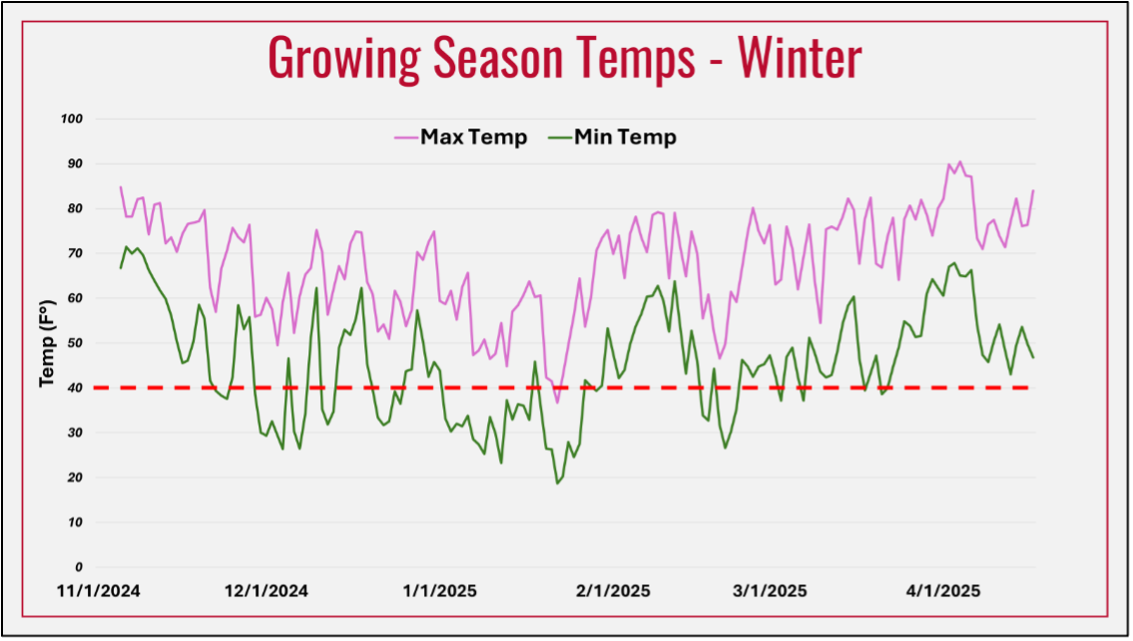
Of course, there are caveats – especially as we get closer to December, the cooler temps can limit early season growth and set us behind on spring “green up”. Selecting an earlier maturing cultivar may be more expensive and not pencil out for your individual operation. If you are participating in an NRCS program, your planting dates are more rigid.
Similarly, there are a couple different oat and crimson clover varieties available in the area, that also fit this scenario. If those are of more interest to you, reach out to your county agent and we can get you that data.
I’ve heard a lot of buzz about oilseed radish (specifically the “Tillage” variety) over the last couple of years. This is one where days to maturity are extremely important to keep in mind. Generally, the radishes you would purchase as a cover crop (either alone or in a mix) will mature by ~120 days…..now compare that to the growing window table shown earlier in this article. Research conducted by NRCS in Georgia has also documented that winter kill of these species has been unreliable in the Southeast – meaning these plants are likely to mature AND SET VIABLE SEED well before we are ready to plant our cash crop. On top of that, their ideal planting/growing window is much earlier than the other cool-season species we plant (see below), so we likely won’t maximize our investment anyways. Considering the challenges we have managing weedy wild radish species, proceed with caution if utilizing tillage radish in your fields.
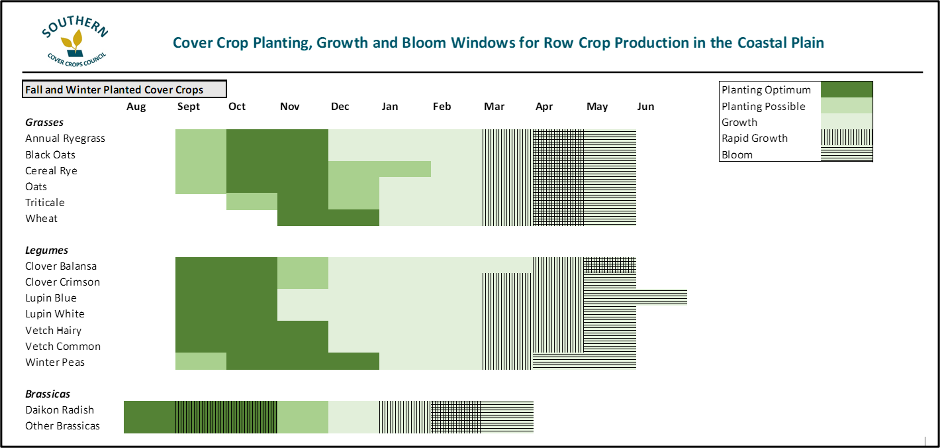
If you are interested in trying cover crops this winter for the first time or want more information about the benefits they bring to your system, please reach out to your county agent and they can share some great information with you. Cover crops aren’t for everyone, but what better way to protect one of our most valuable resources on the farm, than to cover that topsoil and keep it where we need it!! Best wishes for a safe and productive harvest season.
Taylor Singleton
Assistant Professor and Extension Sustainability SpecialistU
niversity of Georgia