


Georgia Cotton Fertility Update – June 2026
Doug Amaral, Plant Nutrition and Soil Fertility Specialist, UGA-Tifton
As we move into the heart of the 2026 cotton season, most Georgia cotton has emerged and is progressing toward squaring, though crop development remains highly variable across the state. Frequent rainfall during planting created favorable moisture conditions in many areas but raised concerns about nutrient availability in some fields. Several nutrient-related issues are beginning to emerge as the crop enters a period of rapid growth and increasing demand.
Heavy Rainfall Raises Sulfur Questions
Sulfur deficiencies have become more common across the Southeast due to reduced atmospheric deposition and the widespread use of highly concentrated, sulfur-free fertilizers. This season’s wet planting conditions have raised additional concerns about sulfur leaching below the rooting zone, particularly on deep sandy soils with low organic matter. Deficiency often appears as pale green or yellow coloration on younger leaves and can be confused with nitrogen deficiency.
Fields that received sulfur preplant or at sidedress are generally in good shape. Growers who relied solely on sulfur-free sources should monitor fields closely. Including 10 to 20 pounds of sulfur per acre remains inexpensive insurance — lean toward the higher end on coarse-textured soils with low organic matter or where significant rainfall has occurred since application.
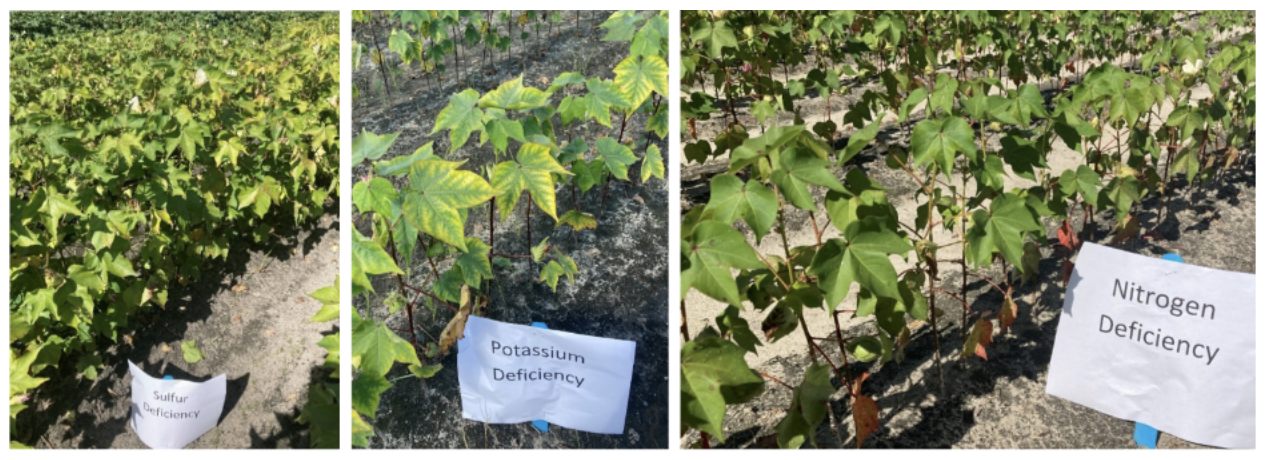
Sulfur deficiency is becoming more prevalent. It also causes a yellowing of the leaves, more on the whole leaf not just between the veins (like K) and will be on the whole plant including in the top or older leaves (unlike N). Source: Post-bloom Nutrient Deficiencies, Waterlogging, and Foliar Feeding - Glen Harris - UGA Cotton Newsletter, August 2022.
Potash Remains the Number One Nutrient Concern
If there is one nutrient that deserves extra attention this season, it is potash (K). As cotton enters reproductive growth, potash demand increases rapidly, and high-yielding crops remove more potassium from the soil — meaning fields that entered the season with marginal soil-test K levels may begin showing deficiency symptoms over the next several weeks.
Growers should scout for yellowing or scorching along leaf margins on older leaves. These symptoms are often mistaken for drought stress or disease, making tissue testing the most reliable tool for confirming deficiencies before visible symptoms become severe. Recent research across the Cotton Belt continues to demonstrate that adequate potash nutrition is essential for both yield and fiber quality.
Magnesium and Manganese Deficiencies
There have been isolated reports of magnesium (Mg), manganese (Mn), and boron (B) deficiencies this season, largely tied to specific soil conditions rather than widespread statewide issues. Magnesium deficiencies are most common on sandier soils or where high potash levels may be limiting uptake. Symptoms appear as interveinal chlorosis on older leaves. Manganese deficiencies have been reported where soil pH is elevated, showing as interveinal chlorosis on younger leaves with veins remaining green.
If Mg deficiency is confirmed, K-Mag (sulfate of potash-magnesia) is a useful corrective option, particularly on fields that could also benefit from additional potash and sulfur. Chelated manganese applied as a foliar spray offer the most reliable uptake and crop response in cases of deficiency.
Final Thoughts
Overall, the 2026 cotton crop is off to a good start despite variable planting conditions. As we move into squaring and early bloom, growers should continue monitoring potash status, remain aware of sulfur needs on sandy soils, and watch for micronutrient symptoms as the crop enters bloom. The next four to six weeks will play a major role in determining yield potential. Timely scouting, tissue testing, and sound agronomic decision-making will help ensure that nutrient management supports the crop through its most critical growth stages.